PERFORMANCE Signal 475
Can Intel finally beat ARM on performance per Watt?
 ↗
↗
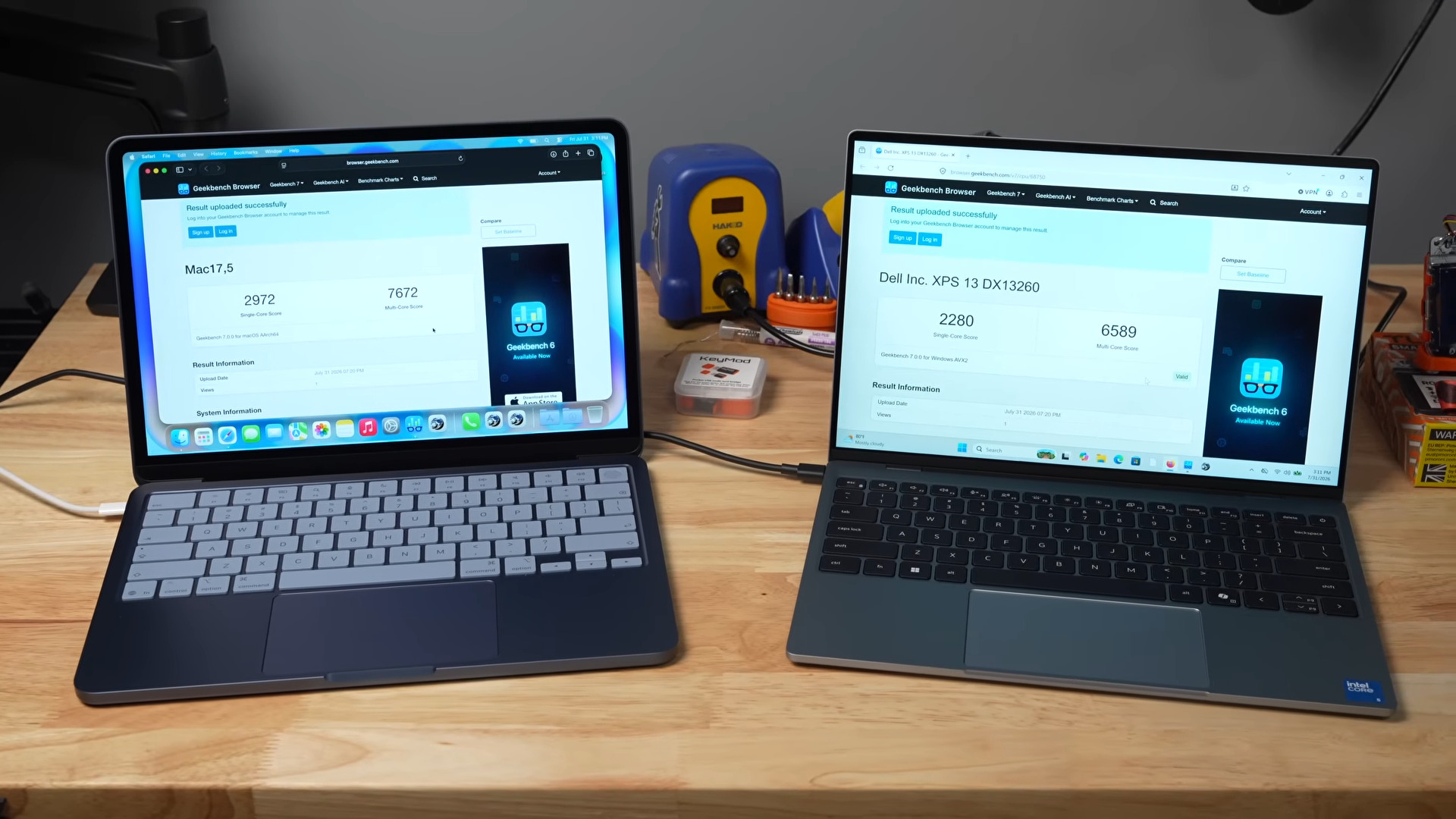
Intel’s latest x86 laptop matches or exceeds the energy efficiency of ARM-based Apple silicon in a standard supercomputer linear algebra test.
Engineers can now consider x86 platforms for power-constrained devices without expecting a large efficiency penalty. This shift may reduce the need to maintain separate code paths for ARM and x86 when energy use is a primary concern.
Written by elseif from the cluster below · every claim links back to a sourceThe three things worth knowing
The Dell laptop delivered 6.21 Gflops per watt, surpassing the MacBook’s 5.38 Gflops per watt in the same test.
During idle or light web browsing, both laptops drew comparable power, showing similar efficiency outside heavy compute loads.
The outcome suggests that ARM’s efficiency edge is more about chip design than the instruction set, as an x86 processor reaches comparable levels.
THE READ
What the cluster adds up to.
Recent measurements show an Intel-based laptop achieving higher floating-point performance per watt than a comparable ARM-based Apple laptop in a standard supercomputer linear algebra test. The result reverses the historical trend where ARM designs led in efficiency. It indicates that the latest x86 silicon can close the gap that once favored ARM in mobile and low-power markets.
Adopting this platform may require recompiling or optimizing existing workloads for the x86 instruction set, but the effort is comparable to any architecture switch. Engineers report that language choice has less impact on efficiency than expected, so high-level languages can still achieve good power numbers. However, teams must still validate power budgets and thermal designs when moving from ARM-centric designs.
The Dell laptop still trails the Apple laptop in integrated graphics performance and operating system flexibility, which may affect workloads that rely on GPU acceleration or specific software ecosystems. The efficiency advantage was observed in a single benchmark and may not extend to all application types or real-world usage patterns. Additionally, the comparison is limited to one generation of chips, so future ARM designs could regain the lead.
Written by elseif from the cluster below · checked for specifics the sources never containedTHE CLUSTER