TECH Signal 436
University of Queensland researchers equip giant burrowing cockroaches with remote-controlled drug delivery systems
 ↗
↗
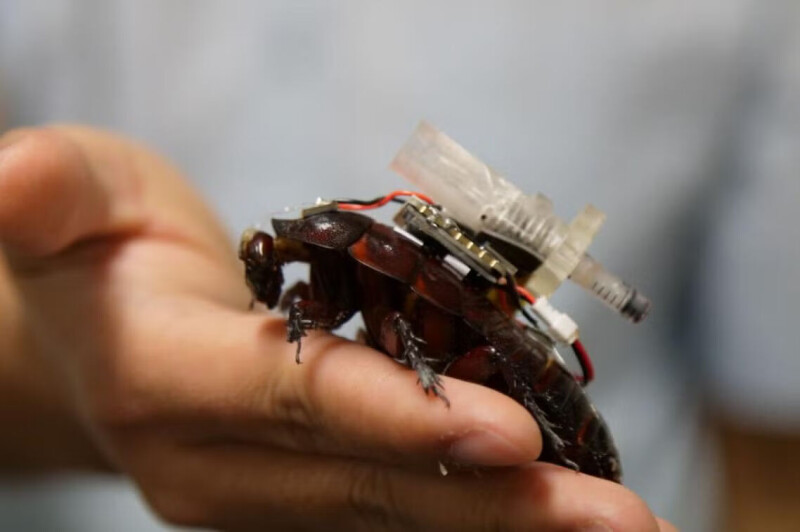
Researchers at the University of Queensland have fitted giant burrowing cockroaches with electrodes and role-specific payloads including drug-injection syringes, achieving high success rates in navigation and injection during lab tests.
If this concept matures, search-and-rescue teams could deploy biologically powered swarms into rubble or confined spaces where human responders cannot reach, delivering emergency drugs to trapped victims. The work also demonstrates a viable model for integrating centimeter-scale actuators and sensors onto living insects without reducing their lifespan. The remaining bottleneck is motion stabilization, which currently succeeds only 72 percent of the time.
Written by elseif from the cluster below · every claim links back to a sourceThe three things worth knowing
Giant burrowing cockroaches were chosen for their size, up to 8 centimeters, allowing integration of centimeter-scale apparatuses for real-world scenarios.
Navigation to target locations succeeded 100 percent of the time, and auto-injection succeeded 90 percent overall, rising to 95 percent when within 15 centimeters of the target.
The researchers predict cyborg insect rescue teams could be deployed in real emergencies within 5 to 10 years.
THE READ
What the cluster adds up to.
The University of Queensland team used the giant burrowing cockroach, the world's heaviest roach species at up to 8 centimeters, because its size accommodates centimeter-scale apparatuses needed for real-world scenarios. Electrodes implanted on the insects give operators remote control over turning, speed, and immobilization, which is critical for aiming the drug-delivery mechanism. The team calls their subjects "paraborgs" and assigns them role-specific payloads: one configuration carries search equipment, another a single launchable drug syringe.
Reported success rates are high for navigation and injection but weaker for stabilization. The paraborgs reached their target locations 100 percent of the time, and the auto-injection mechanism succeeded 90 percent of the time overall, improving to 95 percent when the roach got within 15 centimeters of the target. The weak point is immobilization: only 72 percent of attempts to stabilize the cockroach for injection targeting succeeded, which the team identifies as the remaining engineering challenge before deployment.
The harnesses are non-fatal, and the team reports that subjects lived as long as unmodified roaches once the equipment was removed. PhD candidate Hai Nhan Le is the lead author of the research paper, and Dr. Thang Vo-Doan, director of the UQ robotics engineering lab, envisions swarms carrying cameras, environmental sensors, and specialized medical equipment. Vo-Doan predicts deployment in real emergencies within 5 to 10 years.
Only one feed carried this story, so the framing comes entirely from The Register, which presents it in an offbeat tone while still reporting the technical details. The article does not specify the drug types tested, the electrode implantation method, or the communication protocol used for remote control. Without corroboration from other sources, the performance claims rest on a single report of the research paper.
Written by elseif from the cluster below · checked for specifics the sources never containedTHE CLUSTER