TECH Signal 428 2 feeds carried it
Isar Aerospace Spectrum rocket achieves first orbital launch from Western European soil
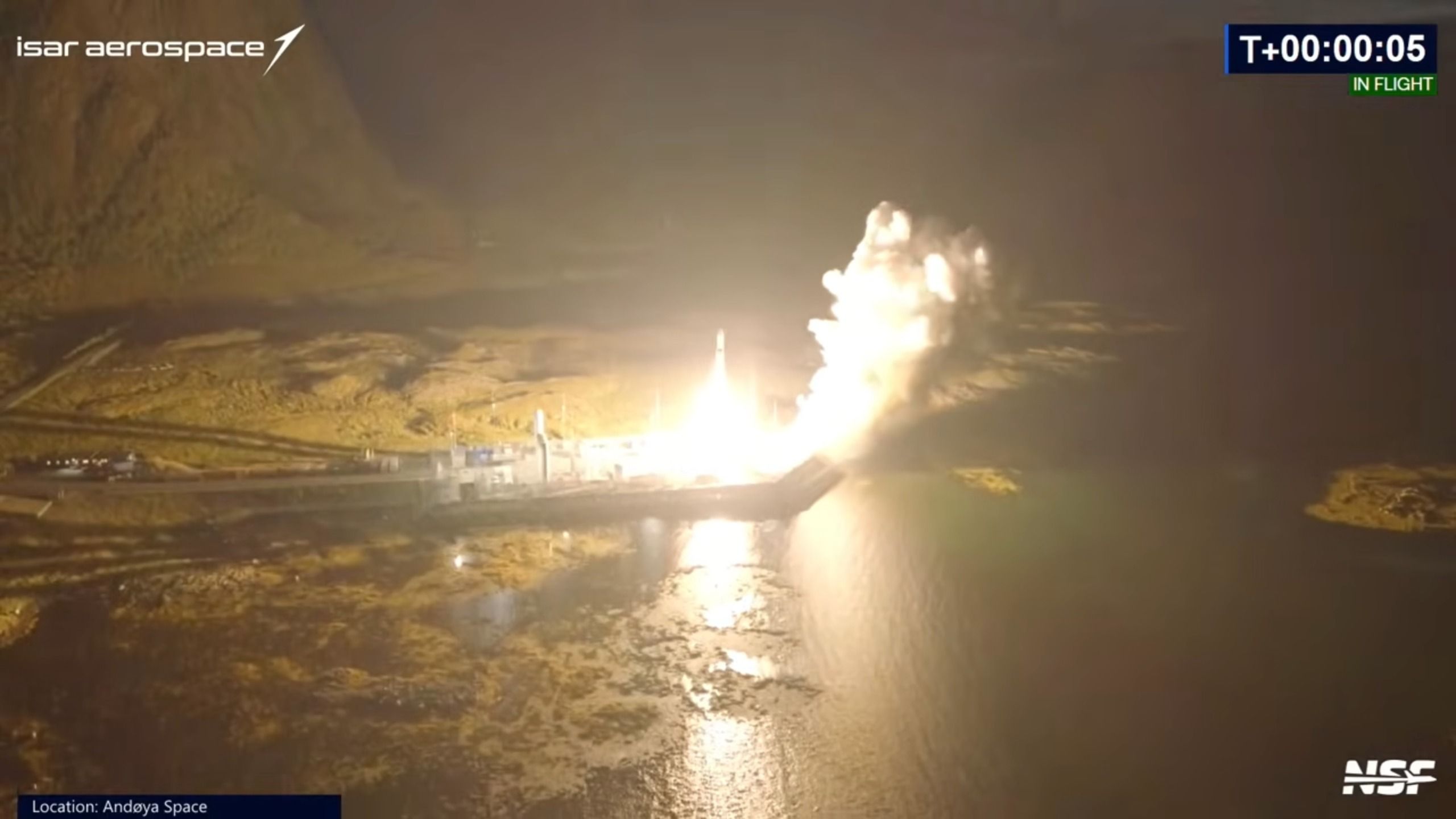 ↗
↗
A private German rocket successfully reached orbit from Norway’s Andøya Space Center, marking a milestone for European spaceflight capabilities.
This launch demonstrates Europe’s growing independent access to space, reducing reliance on non-European launch providers. For engineers, it signals progress in commercial rocketry and potential opportunities for satellite deployment infrastructure in the region.
Written by elseif from the cluster below · every claim links back to a sourceThe three things worth knowing
Isar Aerospace’s Spectrum rocket completed its first successful orbital launch after a prior failed attempt in 2025.
The launch carried five cubesats and a scientific experiment, validating payload deployment capabilities.
The rocket’s 2,200-pound payload capacity and scalable production aim to support small-to-medium satellite missions in Europe.
THE READ
What the cluster adds up to.
Isar Aerospace’s Spectrum rocket achieved orbit on its second attempt, overcoming a 2025 failure caused by a vent valve malfunction and loss of attitude control. The successful launch from Andøya Space Center in Norway marks the first time a rocket has reached orbit from Western European soil, a geographic distinction previously held by Russia’s Plesetsk Cosmodrome. This milestone underscores Europe’s expanding launch infrastructure, though the rocket’s operational range remains limited to polar and sun-synchronous orbits due to the northerly launch site.
The Spectrum rocket’s payload capacity of 2,200 pounds to low Earth orbit positions it as a competitor in the small-to-medium satellite market. Isar’s manufacturing facility near Munich is designed to produce over 30 rockets annually, suggesting a scalable model for frequent launches. However, the rocket’s reliance on a single launch site in Norway may constrain flexibility for equatorial or geostationary missions, requiring partnerships or additional infrastructure for broader market reach.
The launch’s payload deployment, five cubesats and a non-deployable experiment, validates Spectrum’s upper stage performance, including its circularization burn to transition from an elliptical to a stable orbit. This capability is critical for commercial viability, as satellite operators demand precise orbital insertion. The delays and technical setbacks prior to this launch highlight the challenges of developing reliable launch systems, but the successful outcome may accelerate investment in European commercial spaceflight.
For engineers, this event signals progress in Europe’s ability to independently deploy satellites without relying on U.S. or Russian launch providers. The Spectrum rocket’s design and production scalability could lower barriers for European satellite operators, though its long-term competitiveness will depend on cost, reliability, and launch cadence. The focus on small-to-medium payloads aligns with the growing demand for constellation deployments, but larger payloads or interplanetary missions remain outside its current scope.
Written by elseif from the cluster below · checked for specifics the sources never containedTHE CLUSTER