PERFORMANCE Signal 482
Your model already knows the answer: how benchmark answers leak into LLMs
 ↗
↗
Benchmarks that rely on already-known outcomes can be contaminated because language models may have previously encountered the answers.
Engineers depend on benchmark scores to gauge model reasoning and to choose systems for production. If a model simply recalls an answer it has seen, the score no longer reflects true capability, leading to over-optimistic deployments. Switching to forward-looking or live benchmarks can restore confidence but requires new data pipelines and may not be viable for all tasks.
Written by elseif from the cluster below · every claim links back to a sourceThe three things worth knowing
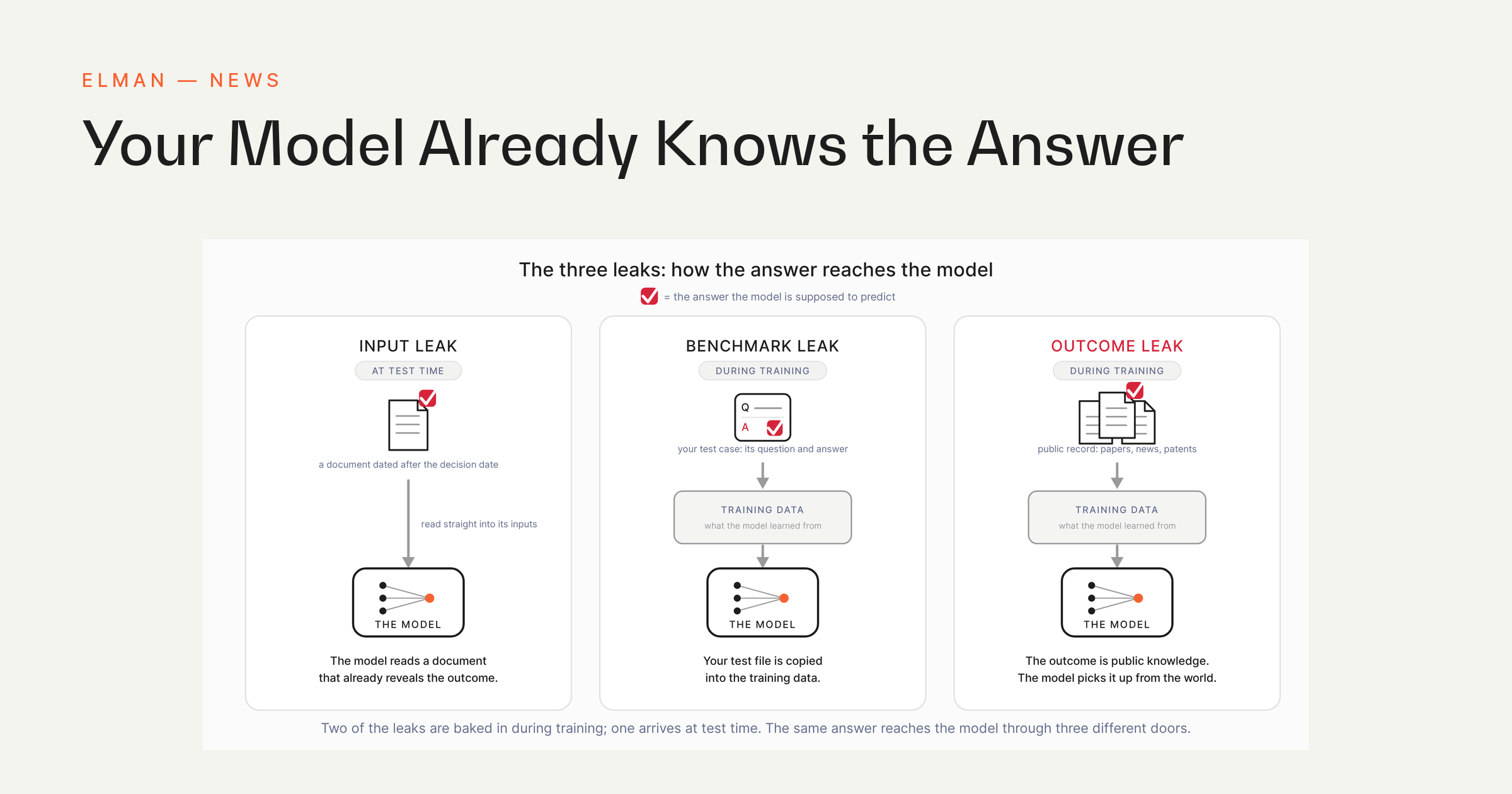
Answers can reach a model through test-time documents, prior inclusion of the benchmark itself, or prior exposure to the public outcome.
Benchmarks built from historical events are especially vulnerable to these leaks, making their scores ambiguous.
Live or forecasting benchmarks that target unrevealed events reduce leakage, though they demand continuous data collection and only apply where future outcomes are available.
THE READ
What elseif makes of it.
Evaluating a model on a problem with a known answer is attractive because the ground truth is real, but it also opens a cheating path. Since models ingest large swaths of internet text, they may have already seen the question, the answer, or both before the test is run. Consequently, a high score can mask the difference between genuine reasoning and simple memorization.
Three distinct pathways let the answer slip into the model. The first occurs at inference time when the model reads a document that already announces the result, effectively giving it the future. The second happens when the benchmark data itself becomes part of the model's training corpus, so the model memorizes both the prompts and the solutions. The third route is more subtle: the outcome is a public fact that the model has learned from countless sources during pre-training, so even a brand-new test set cannot hide it.
For engineers, this contamination means that benchmark numbers no longer guarantee that a model can solve novel instances of the problem. Model selection, hyper-parameter tuning, and downstream deployment decisions that rely on such scores risk being based on inflated performance. Auditing benchmarks for possible leaks becomes a necessary step before trusting the results.
One way to mitigate the issue is to avoid historical outcomes altogether and score models only on events that have not yet resolved. Live platforms that refresh questions on a schedule or forecasting suites that predict future happenings can limit all three leak routes. However, these approaches require infrastructure to generate and evaluate fresh queries and are only applicable where future data can be obtained in a reasonable timeframe.
Practically, teams should assess the leakage risk of any benchmark they use, consider timestamping inputs to block outcome leaks, and explore holding out truly unseen future cases for validation. In domains with long-term horizons, such as clinical trials, the cost of waiting for real outcomes may be prohibitive, so alternative evaluation methods, like simulated environments or synthetic data, might be needed to approximate genuine reasoning ability.
Written by elseif from the cluster below · checked for specifics the sources never containedTHE CLUSTER