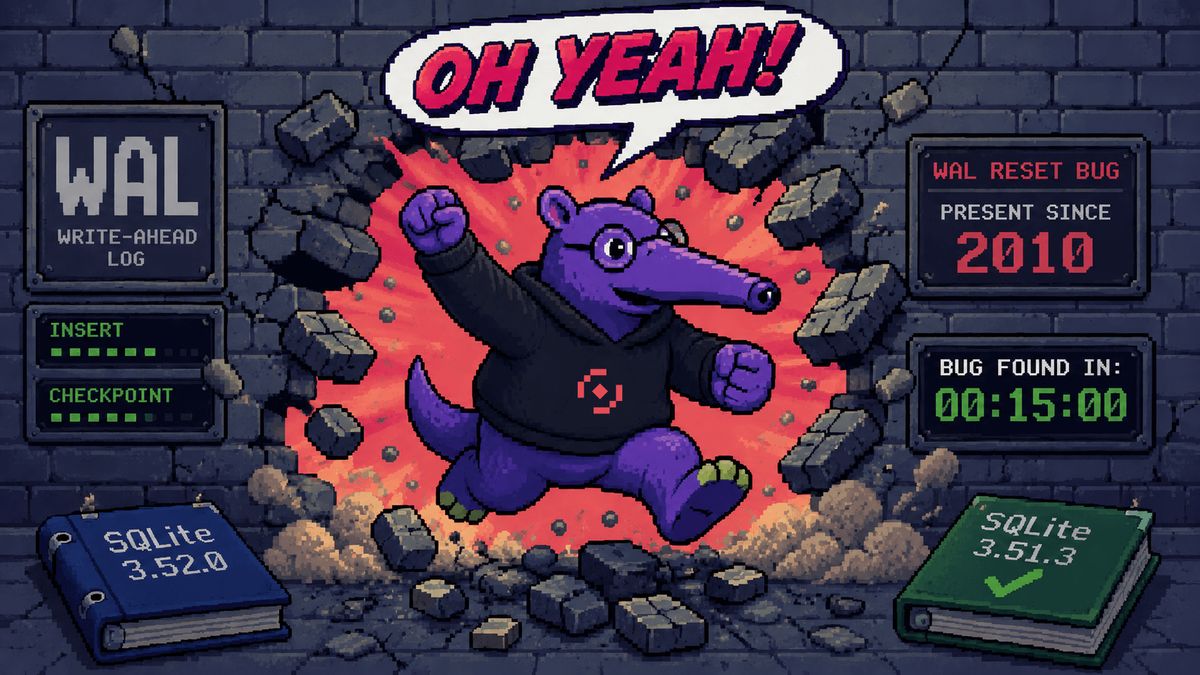
Critical CVE issued for hallucinated SQLite vulnerability
Why it matters — Only one feed elseif tracks has carried this so far, so there is no independent corroboration yet. Read it as a single-source report.
TOPIC
Storage engines, query planners, and the pipelines that move data between them. Benchmarks with methodology, migrations with real numbers, and the failure modes worth designing around before you meet them.
DATABASES
Why it matters — Only one feed elseif tracks has carried this so far, so there is no independent corroboration yet. Read it as a single-source report.
Why it matters — The material provided is essentially a single headline with no technical, financial, or integration detail beyond the purchase price and a one-line description of BioCatch's purpose. Only one feed carried the story, so there is no corroboration to draw on. The assigned topic is Databases, but nothing in the supplied text describes storage, query, or data-platform mechanics; the substance is payments and fraud-prevention AI, so a database-specific angle cannot be supported from what is here.

Why it matters — This is a consumer buying guide for iPhone magnetic wallet accessories, not a story with engineering or database relevance; the only feed carrying it is ZDNET, so there is no corroboration to weigh. There is no material in the supplied extract that touches on databases, data systems, or storage. As such, there is little a working engineer or operator can act on beyond knowing it exists as a curated list.
Why it matters — Engineers can expect forthcoming advances in query processing, data structures, and performance that may be incorporated into ClickHouse and PostgreSQL. The open‑source focus means the research outcomes will be publicly available, allowing teams to adopt and extend new techniques without waiting for proprietary releases. Pavlo’s expertise in autonomous databases and large‑scale analytics aligns with the growing AI‑driven workload demands that many real‑time analytics platforms face.
Why it matters — This event is not directly relevant to engineering or databases. The material provided does not describe any technical systems, architectural patterns, or operational implications for software development. No substantive takeaway for engineers can be derived from the given context.
Why it matters — Engineers can now test and compare dozens of database systems side by side without manual setup, making it easier to evaluate options for specific workloads. The refactored common interface ensures fair comparisons by enforcing cold-start measurements and preventing caching tricks. This lowers the barrier to benchmarking and helps engineers make informed decisions about database selection.
Why it matters — IBM i represents a fundamentally different systems engineering approach where the OS and database are a single unit, eliminating the communication overhead between separate layers. For engineers accustomed to bolting a database onto Linux or Windows, this architecture shows that native kernel-level understanding of data structures yields concrete advantages in OLTP performance, security through encapsulation, and binary compatibility spanning decades.
Why it matters — Engineers building on or contributing to open-weight AI models may find the ecosystem financially constrained, impacting the longevity and support of these tools. The skepticism from investors challenges the commercial viability of open-weight approaches compared to proprietary alternatives.
Why it matters — If your code calls commit() inside nested helpers beneath a transaction decorator, the atomicity guarantee is an illusion—partial writes can persist on failure. The author argues the only reliable fix is to confine all DB sessions, transactions, queries, and models strictly within a dedicated DB access layer and to enforce that boundary with AST-based linters or test suites that ban manual commits and DB model imports outside that layer.
Why it matters — Digital evidence systems that produce files from physical DNA scans have integrity vulnerabilities that AI-generated code can exploit without detection. For engineers building or auditing forensic data pipelines, this highlights that file-level integrity checks on digitized evidence may be insufficient against sophisticated tampering.
Why it matters — For engineers building automated decision systems, this provides a concrete architecture pattern for combining multiple independent analysis agents with a risk gate that can override consensus. The backtest results demonstrate the inherent tradeoff: conservative risk thresholds that correctly identify high-uncertainty periods also cause missed opportunities in trending markets, resulting in underperformance versus buy-and-hold.
Why it matters — This release patches a stack buffer overflow, a double-free causing heap corruption during SQLDisconnect, and several out-of-bounds read conditions that could crash or compromise applications using the driver. Engineers connecting to PostgreSQL via ODBC should upgrade promptly to avoid stability and security exposure.
Why it matters — This approach eliminates the need to compile extensions locally or include build tools in production database images, streamlining container builds. It also provides pre-configured images matching managed services like Azure Database for PostgreSQL, simplifying local development and testing. For PostgreSQL 18 and later, the project leverages new path configurations to isolate extensions, preventing file collisions and enabling deploy-time mounting.
Why it matters — Engineers can begin testing upcoming features like temporal tables, property graph support, and virtual generated columns against real workloads. Several fixes in Beta 2 address notable regressions from Beta 1, including an autovacuum multixact-age calculation that could become infinite, making this a more viable target for early compatibility testing.
Why it matters — When a PostgreSQL instance won't start, standard SQL-based recovery tools become unavailable, leaving operators with limited options. PDU provides a direct file-level recovery path that doesn't modify the original data directory, offering a way to extract data even from corrupted catalogs or damaged files. Note: this is reported by only one feed.
Why it matters — If you're still on the 3.x branch of sqlite-utils and rely on table.delete_where(), this patch brings the fix to you without requiring a major version upgrade. Only one feed carried this item, so corroboration is limited.
Why it matters — Engineers who reach for SQLite on small sites still need to think about database operations. The single-writer constraint creates real operational friction when long-running writes block other workers, and query performance can degrade dramatically without up-to-date planner statistics.
Why it matters — A top-tier mathematician moving to OpenAI signals that AI safety work is attracting serious academic talent beyond traditional software engineering. For engineers, this suggests AI safety is becoming a core concern requiring deep theoretical expertise, not just applied implementation.
Why it matters — The shutdown illustrates how experimental community and governance projects face concrete regulatory barriers even with prominent Silicon Valley backing. The planned relocation to Kazakhstan suggests founders may shop for more permissive jurisdictions, a pattern worth watching if similar projects emerge.
Why it matters — This is a concrete example of how a firmware supply chain failure in a hardware security device can lead directly to mass asset theft. Engineers responsible for key storage or hardware wallet integration must now treat firmware integrity verification as a life-or-death requirement, not a best-effort check.
Why it matters — If you operate OpenBSD-based infrastructure using relayd or httpd, these daemons are no longer effectively unmaintained — active commits are landing again. The security improvements (stricter TLS defaults, duplicate header rejection, parser differential fixes) and crash-fixing race condition patches directly affect production reliability for reverse-proxy and load-balancing workloads.
Why it matters — This demonstrates how a single code change that silently degrades a security-critical component can have catastrophic and irreversible consequences—existing compromised seeds cannot be fixed by a firmware patch, requiring complete wallet migration. Engineers building systems that rely on hardware security features must ensure fallbacks are explicit and detectable rather than silent.
Why it matters — Operators of critical infrastructure face expanding nation-state targeting, as the FBI warns similar attacks are spreading to other states. Political misattribution of incidents can muddy response coordination and distract from hardening operational technology systems that remain vulnerable to foreign adversaries.
Top stories right now