ELSEIF
Your brief EB
443 stories from 199 feeds 1253 clusters Refreshed 11 minutes ago next pull 19:11

TOPIC

Performance

Profiling, benchmarks, and the hunt for the bottleneck that actually matters. Work that reports a baseline, a method, and a number you could reproduce yourself.

3TODAY
8FEEDS
4mMEDIAN
FEEDS Hacker News 63 Phoronix 46 Lobsters 31 Tomshardware 24 Techmeme 18 InfoQ 9 The New Stack 7 www.theregister.com - Articles 5

PERFORMANCE

Everything in Performance.

02 367 new

Performance Techmeme

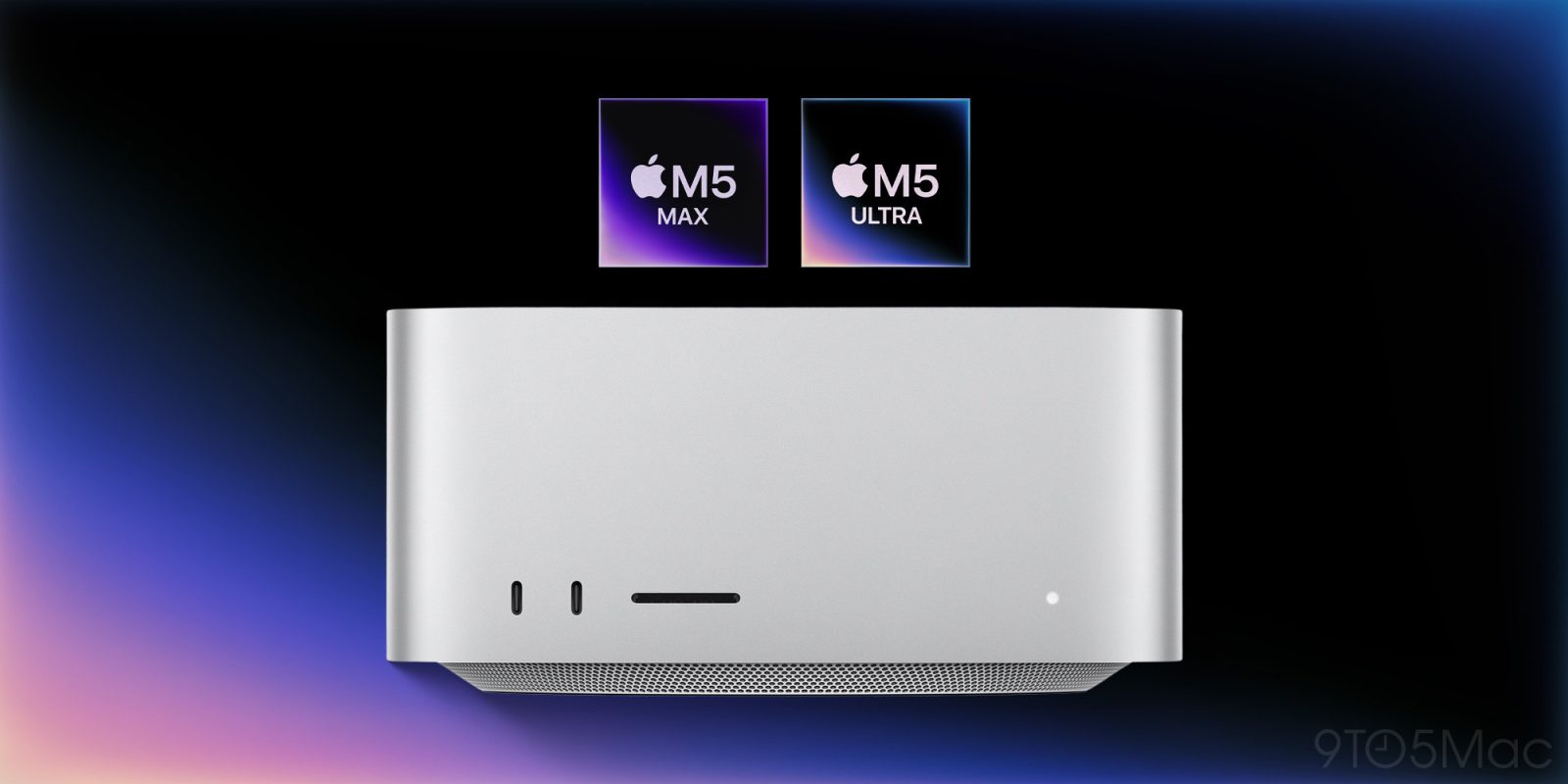
Apple unveils new Mac Studio with M5 Max and M5 Ultra

Why it matters — The update shifts the Mac Studio’s focus toward AI acceleration and memory capacity, making it a stronger option for local AI development and high-performance computing. However, the gains may not justify upgrades for users without AI-specific needs. Availability and pricing could limit adoption for smaller teams.

5 feeds
60 min
04 329 -3

Performance Phoronix

Fujitsu Formally Announces Their MONAKA 144 Core CPU

Why it matters — The MONAKA CPU represents a significant advancement for Fujitsu in the Arm-based server processor market. Its introduction could impact performance benchmarks and competitive positioning in the server space. Additionally, the upstreaming of compiler support suggests a commitment to software ecosystem development.

1 feed
2 min
05 303 new

Performance Daniel Lemire's blog

Python sets and dictionaries can have quadratic-time performance

Why it matters — Relying on the assumption that Python hash tables are strictly O(1) can lead to severe performance degradation in applications processing large or adversarial inputs. For read-heavy workloads with known keys, alternative data structures like fastconstmap can avoid cache misses and maintain significantly lower lookup times.

3 feeds
5 min
07 303 new

Performance malisper.me

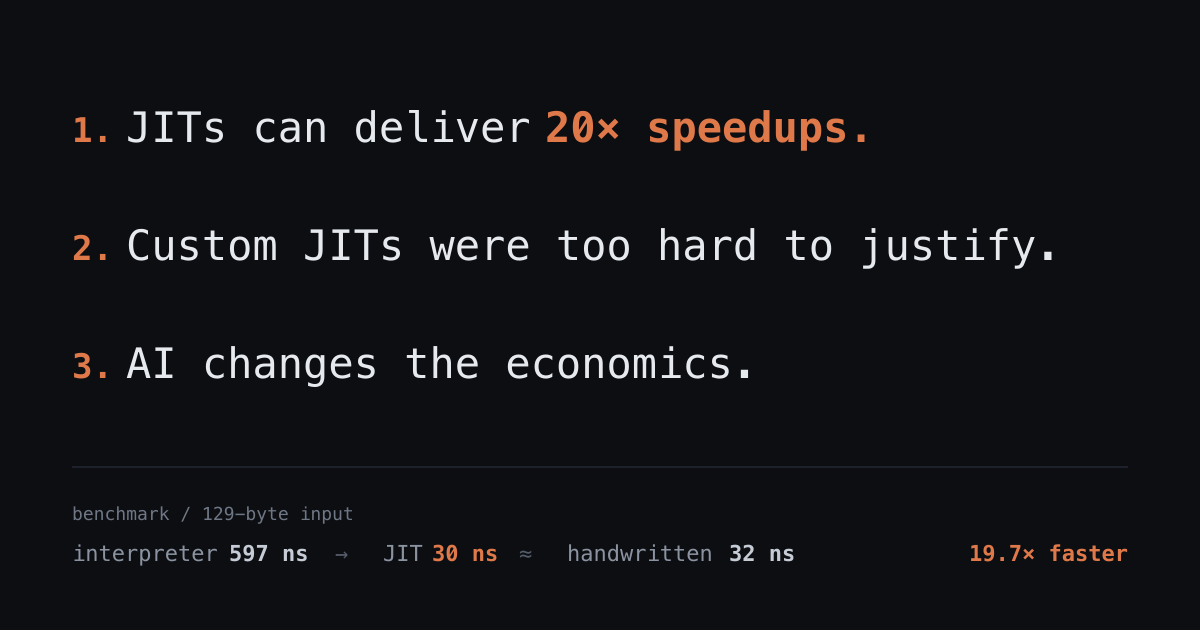
pgrust JIT compiler compiles SQL queries in around 5μs using copy-and-patch

Why it matters — Traditional database JIT compilers rely on LLVM or C/C++ code generation, both of which have high compile times that limit when compilation is worthwhile. At 5μs, the compilation cost is low enough to apply JIT optimization to every query, including single-execution ones. The author also notes that AI assistance made directly targeting assembly far more approachable than historically expected.

3 feeds
15 min
09 298 new

Performance matklad

TigerStyle's static allocation and constant work patterns avoid pool use-after-free by pre-allocating all objects at startup

Why it matters — If you build systems with object pools, the type system does not track which generation of object occupies a slot, so a stale pointer can silently read bytes belonging to a different object. Pre-allocating a fixed maximum at startup and rejecting surplus requests trades a small loss of flexibility for a guarantee that overload degrades gracefully instead of triggering an OOM kill that loses every in-flight request.

3 feeds
7 min
12 257 new

Performance Techmeme

Meta releases Muse Spark 1.3 in Muse Code and API with claimed coding and agentic gains at unchanged pricing

Why it matters — Teams already on Spark 1.2 get a claimed performance bump at no additional cost, which simplifies upgrade decisions. The emphasis on agentic performance signals Meta is pushing toward multi-step autonomous workflows, though no benchmarks or specifics are provided in the available material. Without independent verification, the significance of the improvements remains unconfirmed.

2 feeds
80 min
13 252 new

Performance Quesma Blog

RTK token compression shows mixed cost impact in terminal benchmark tests

Why it matters — RTK’s promise of cheaper AI coding via token compression is appealing, but real-world cost savings depend on model behavior and task specifics. Engineers adopting RTK must validate its impact on their own workflows, as advertised token reductions don’t always translate to lower bills. The tool’s limitations, such as potential pass-rate drops or task-specific inefficiencies, highlight the need for rigorous testing before deployment.

2 feeds
6 min
14 252 new

Performance github.com

Assembly Hall of Shame

Why it matters — Engineers can see which instructions suffer the most from microcode assists, cache-line splits, or uncore traffic, revealing hidden worst-case paths. This insight helps in sizing timing budgets for real-time or safety-critical code and in evaluating the impact of contention-based attacks.

2 feeds
8 min
15 252 new

Performance vectorware.com

Rust SIMD on the GPU

Why it matters — Engineers can write a single Rust function using portable SIMD types and have it execute on both CPUs and GPUs without rewriting for vendor intrinsics. The approach treats a GPU warp as a vector unit, so the same arithmetic, comparison, and reduction code maps to a single warp instruction. Adoption requires a Rust toolchain that emits GPU kernels and enables the portable_simd feature, but no special GPU annotations are needed.

2 feeds
9 min
17 252 new

Performance apple.com

Apple debuts M6 as first 2nm chip and M5 Ultra as first quad-die M-series SoC

Why it matters — M6's 2nm process and Dual Neural Engine deliver up to 2x peak AI compute and nearly 30% more GPU AI performance over M5, making on-device LLM workflows significantly faster. M5 Ultra's quad-die architecture provides 1.2TB/s unified memory bandwidth, 50% more than M3 Ultra, enabling desktop machines to run massive AI models locally.

2 feeds
15 min
18 252 new

Performance build2.org

Faster Than Ninja

Why it matters — For engineers choosing a build system, this comparison indicates that Ninja's speed advantage is partly due to offloading work to a generation step (like CMake), which adds time. build2 offers more built-in features (like token-based change tracking) that can be disabled to achieve similar performance, giving teams flexibility without sacrificing speed.

2 feeds
12 min
20 247 new

Performance Eileen Yoon

Apple M3 Neural Engine DRAM throughput reportedly throttles at 1 MiB weight multiples restoring 27 GB/s gain

Why it matters — Engineers running small-batch inference on M3 Macs can recover 2 to 3× token throughput by avoiding 1 MiB-aligned weight tensors. The fix is a one-line kernel change but requires retraining or padding models that hit the erratum. No silicon revision is available yet so the workaround remains necessary for affected models.

2 feeds
15 min
21 247 new

Performance Waymo

Waymo reveals custom 5nm ASIC and full-stack compute for fully autonomous driving

Why it matters — Autonomous driving requires deterministic, low-latency compute that off-the-shelf hardware cannot reliably provide. Waymo’s custom silicon and full-stack optimizations demonstrate the scale of investment needed to meet safety and performance demands. This sets a benchmark for edge AI compute in safety-critical applications.

2 feeds
4 min
22 239 new

Performance Linebender

fearless_simd v0.7 adds 64-bit integers, explicit SSE2 level, and improved generics ahead of v1.0

Why it matters — The 64-bit integer support completes full type coverage for integer and float vectors, removing a gap caused by uneven hardware support for 64-bit SIMD operations. The explicit SSE2 level lets crates that don't need runtime dispatch avoid its overhead while using real SIMD intrinsics rather than scalar fallback. Improved trait-based generics make it practical to write functions generic over vector types without resorting to macros or additional crates like paste.

2 feeds
6 min
24 234 new

Performance lemire.me

Profile-guided optimization in Go

Why it matters — For performance-sensitive Go applications, PGO offers a low-effort path to small but measurable gains by replacing compiler heuristics with actual runtime data. The process requires collecting a representative profile and performing a second build, but carries a low risk of significant regressions on unprofiled workloads due to the conservative nature of Go's optimizations.

2 feeds
4 min
25 234 new

Performance stefan-marr.de

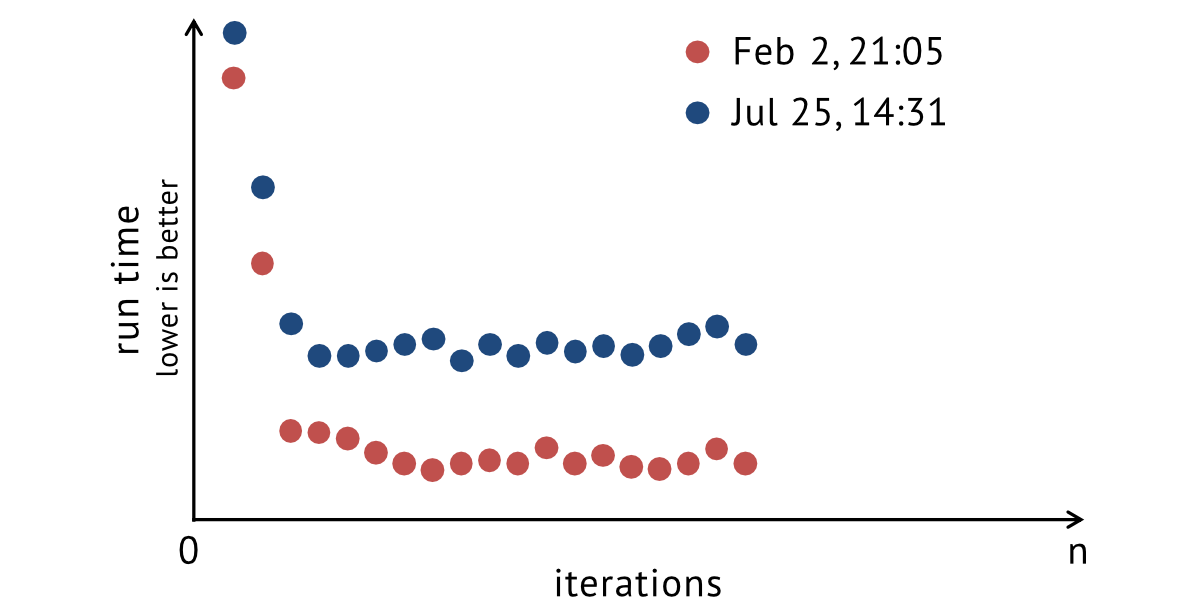
Benchmarking on modern systems reveals unpredictable performance variations despite deterministic workloads

Why it matters — Engineers rely on benchmarks to optimize and validate performance, but modern systems introduce noise that can mislead conclusions. Ignoring these pitfalls risks basing decisions on flawed data, leading to suboptimal or incorrect optimizations. Understanding these limitations is critical for designing reliable benchmarks.

2 feeds
7 min
27 220 new

Performance computerenhance.com

"Clean" Code, Horrible Performance (2023)

Why it matters — Engineers building performance-critical loops will see higher CPU latency from virtual dispatch and pointer indirection. The example shows that adhering strictly to readability-focused rules can outweigh their maintenance benefits in hot code paths.

1 feed
19 min
28 184 new

Performance github.com

Homebench – Benchmark local LLMs for speed, memory, and quality

Why it matters — Engineers running models on their own hardware currently stitch together llama-bench for speed and lm-evaluation-harness for quality, with no shared view of how those numbers trade off on the same machine. homebench removes that glue by caching results, diffing successive runs, and exporting Markdown or JSON reports, so a hardware swap, quantization change, or model upgrade produces a comparable record. The optional LLM-as-judge and a throughput sweep at concurrencies of 1, 2, 4, and 8 make it usable for both laptop sizing and small-server capacity planning.

1 feed
9 min
29 177 new

Performance arxiv.org

When AI Benchmarks Plateau: A Systematic Study of Benchmark Saturation

Why it matters — When benchmarks stop providing clear performance gaps, engineers lose a reliable signal for model selection and deployment decisions. The paper identifies design factors, especially expert-curated test sets, that can keep benchmarks useful longer, suggesting a shift in how evaluation suites should be built and maintained.

1 feed
3 min
30 177 new

Performance global.fujitsu

Fujitsu launches made-in-Japan next-generation CPU FUJITSU-MONAKA

Why it matters — Fujitsu's launch of the FUJITSU-MONAKA CPU signifies a potential advancement in processing capabilities. This CPU could enhance performance in various computing applications. Additionally, being manufactured in Japan may have implications for supply chain resilience.

1 feed
4 min
37 155 new

Performance LWN.net

Linux kernel advances memory tiering with mixed DRAM, high-bandwidth and CXL memory

Why it matters — Memory tiering allows engineers to balance cost, capacity, and performance by assigning workloads to the most appropriate memory type. This development could reduce hardware expenses for large-scale systems without sacrificing critical performance. However, adoption requires careful tuning to avoid misplacing allocations and degrading performance.

1 feed
2 min
40 154 -1

Performance Phoronix

OpenVDB Introduces SIMD Framework With Some 2~4x Performance Improvements

Why it matters — The introduction of the SIMD framework could significantly enhance the performance of applications utilizing OpenVDB. This improvement is particularly relevant for CGI software, which relies on efficient handling of sparse volumetric data. A 2 to 4 times performance boost can lead to faster render times and improved workflows for artists and developers.

1 feed
2 min
44 143 new

Performance modelrift.com

CadQuery and OpenSCAD produce printable parts under AI agents but fail differently in geometry validation

Why it matters — Engineers relying on AI agents for automated CAD workflows must account for tool-specific failure modes. Silent geometry errors in CadQuery could lead to unprintable or structurally flawed parts, while OpenSCAD’s errors are explicit but require more iterations to resolve. The choice of tool impacts both reliability and debugging overhead in unattended workflows.

1 feed
12 min
45 143 new

Performance withspecific.com

New Real-SWE benchmark tests AI agents on licensed enterprise codebases

Why it matters — Existing benchmarks rely on expert-generated or synthetic tasks that lack the complexity of actual production environments. Real-SWE forces agents to navigate proprietary systems, business rules, and infrastructure tooling, providing a measure of how well models handle the verbatim tasks enterprise engineers face. The initial results show a resolution rate of 38.8% for the top model, highlighting significant gaps in current capabilities.

1 feed
9 min
47 142 new

Performance iaea.org

Cherenkov Radiation - traveling faster than light

Why it matters — The only information provided is the headline claiming Cherenkov radiation travels faster than light. No article body or additional details are available to substantiate or contextualize the claim. Consequently, no further technical implications can be derived from the given material.

1 feed
4 min
49 142 new

Performance pantheongpu.com

PantheonGPU introduces GPU health testing and AI workload benchmarking suite

Why it matters — It provides a single tool that works on both NVIDIA and AMD GPUs, eliminating the need for separate vendor utilities. Engineers can install it via a Debian package on Ubuntu/Debian or via a portable bundle on RHEL-family systems, then run targeted stress tests and retain telemetry for regression analysis. This streamlines GPU validation and helps detect hardware issues before they affect AI workloads.

1 feed
2 min
51 142 new

Performance ixuvo.com

TigerBeetle Eliminates Runtime Memory Allocation to Achieve Deterministic Sub-Millisecond Tail Latency

Why it matters — For engineers building high-throughput transactional systems, TigerBeetle demonstrates that eliminating dynamic memory allocation after initialization removes heap fragmentation and garbage collection as sources of unpredictable latency. The trade-off is rigidity: maximum connections, batch sizes, and cache sizes must be defined at startup or compile time, and workloads exceeding these limits will fail rather than degrade gracefully.

1 feed
10 min
54 142 new

Performance hackaday.com

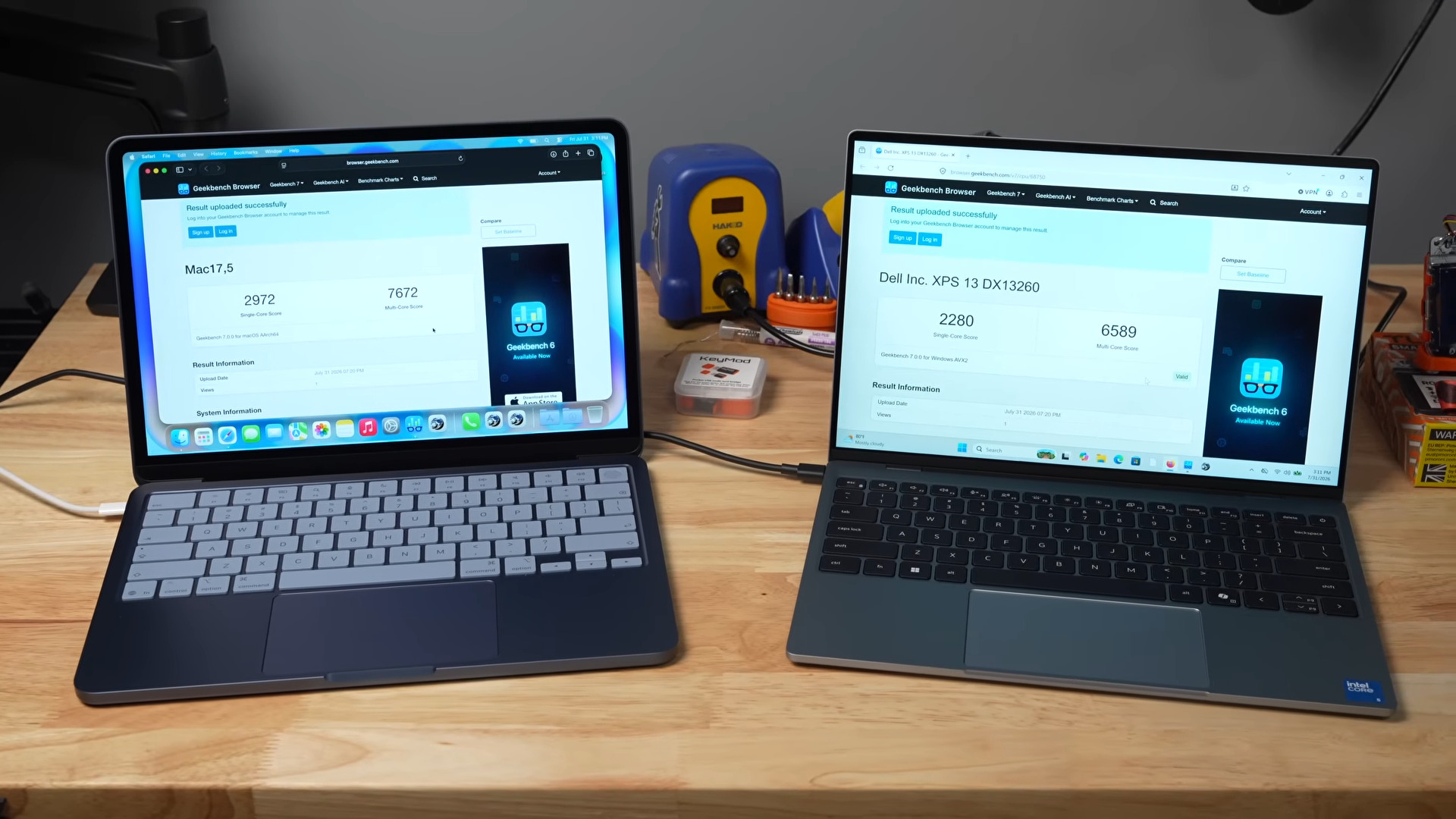
Can Intel finally beat ARM on performance per Watt?

Why it matters — Engineers can now consider x86 platforms for power-constrained devices without expecting a large efficiency penalty. This shift may reduce the need to maintain separate code paths for ARM and x86 when energy use is a primary concern.

1 feed
2 min
55 142 new

Performance arxiv.org

Zigbee vs. Matter over Thread:Understanding IoT Protocol Performance in Practice

Why it matters — Engineers choosing a wireless stack for smart-home devices must balance responsiveness against network growth potential. The paper shows that Zigbee excels in small, static meshes, while Matter-over-Thread maintains performance as hops increase. These findings guide hardware selection and firmware design for differing deployment scales.

1 feed
3 min
56 142 new

Performance github.com

Ruby 4.0 Ractor web server Kino delivers 1.5-2× throughput with 4-7× less memory than Puma clusters

Why it matters — Ruby’s Global VM Lock (GVL) forces production servers to fork processes, doubling memory costs per core. Kino’s Ractor mode bypasses the GVL, cutting memory use while raising throughput on both I/O and CPU workloads. The threaded fallback keeps Rails compatibility but still halves memory versus Puma clusters.

1 feed
15 min
58 142 new

Performance ttias.be

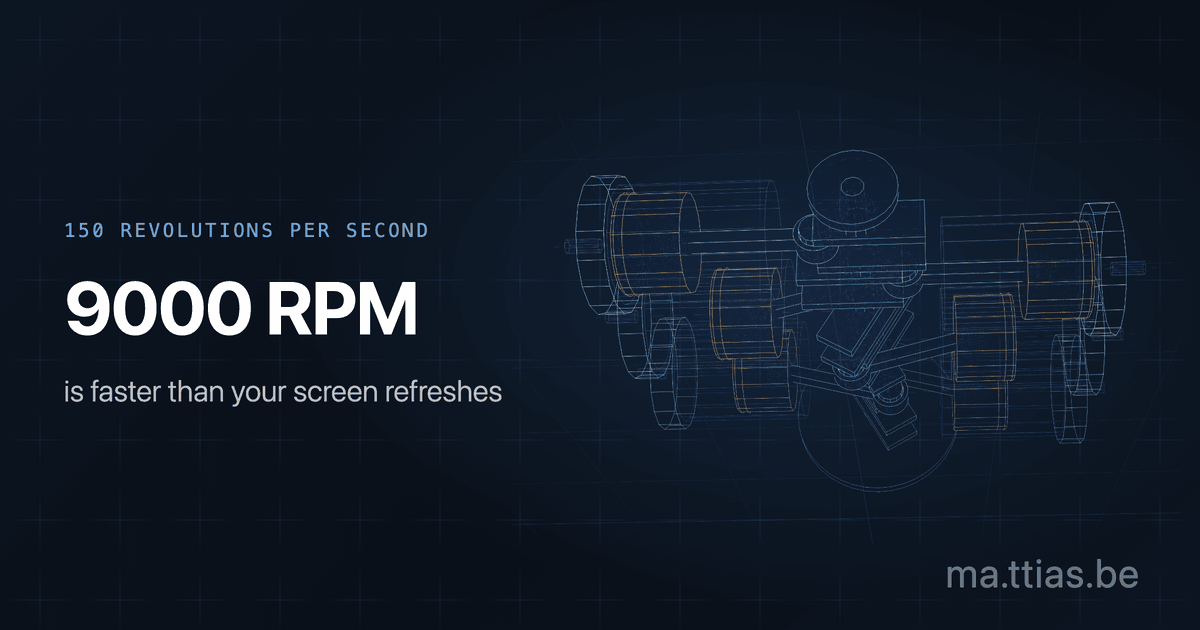
Interactive animation visualizes how 9000 RPM exceeds screen refresh rates

Why it matters — For engineers working with high-speed mechanical systems or real-time visualization, this highlights a fundamental perceptual limitation: standard display refresh rates cannot faithfully represent rapid rotational motion without aliasing or blur. The tool provides a way to slow down and inspect crankshaft geometry and firing orders across four engine layouts at 1/50th speed.

1 feed
2 min
60 142 new

Performance artificialanalysis.ai

Qwen3.8-Flash-Next ranks fourth in intelligence among 110 models with 180B total and 6B active parameters

Why it matters — For teams evaluating open-weights LLMs, the 6B active parameters per token on a 180B total model suggest strong inference economics if the listed $0.00 pricing holds. The 200M token verbosity during benchmarking signals that production cost and latency could be higher than raw speed metrics imply, since the model generates nearly twice the median token volume per task.

1 feed
36 min
63 142 new

Performance github.com

Array-backed LRU hash table eliminates runtime allocations and global lock contention

Why it matters — By removing global locks and per-operation allocations, the design reduces tail latency and improves throughput on many-core systems. This makes it attractive for latency-sensitive layers such as caching, network routing, storage subsystems and kernel components where standard containers become a bottleneck.

1 feed
18 min
65 142 new

Performance springer.com

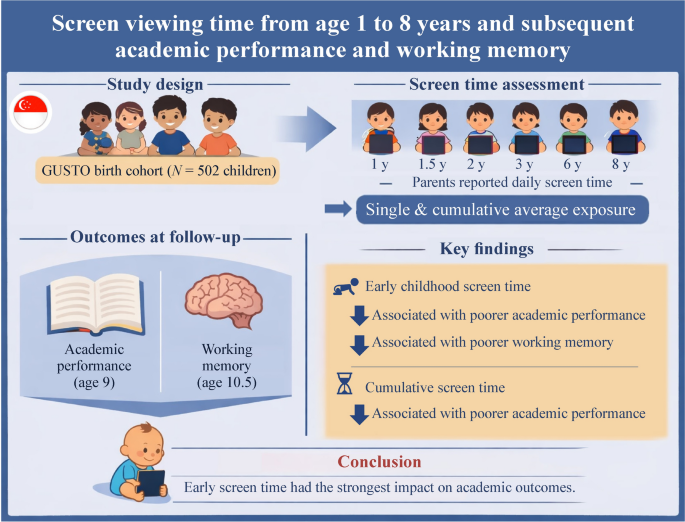
Higher screen time from ages 1 to 8 linked to lower academic performance at age 9

Why it matters — The study found that higher screen time at ages 1, 1.5, and 6 years predicts lower academic performance at age 9, and higher screen time at ages 1 and 6 predicts poorer working memory at age 10.5. For engineers building apps or devices used by young children, this indicates that features encouraging prolonged viewing may negatively affect later learning outcomes.

1 feed
2 min
68 142 new

Performance LWN.net

Tail-call optimization in C is relatively recent

Why it matters — Engineers building VMs or interpreters can now use tail-call-based dispatch to scale to hundreds of thousands of specialized code snippets, rather than being limited to roughly 2,000 with computed goto. This unlocks optimization techniques like aggressive superinstruction formation that require many more code variants than goto*-based systems can practically handle.

1 feed
2 min
69 142 new

Performance infrequently.org

Updated 2026 network and device benchmarks reveal growing performance inequality as page sizes outpace budgets

Why it matters — The updated benchmarks target the 75th percentile, meaning a quarter of users experience slower-than-baseline performance when pages exceed these limits. Growing JavaScript payloads widen this gap, turning performance into both a technical shortfall and an ethical issue for less-privileged audiences.

1 feed
31 min
70 142 new

Performance keenable.ai

Keenable introduces NEEDLE, a live open-source benchmark for agentic web search that resists memorization

Why it matters — Static search benchmarks can be gamed by models that memorize answers or even fetch the benchmark's own answer key from HuggingFace during evaluation, making existing quality measurements unreliable for agentic workloads. NEEDLE addresses this by refreshing queries continuously, so there is nothing fixed to memorize or leak, giving engineers a more trustworthy signal when comparing search engines for agent traffic.

1 feed
20 min
71 142 new

Performance claude.com

Claude reports degraded performance across several models and services

Why it matters — Elevated errors on requests to multiple Claude models can disrupt applications that depend on the service for generative AI tasks. Until the investigation concludes, developers may need to implement retry logic or consider alternative providers to maintain reliability.

1 feed
1 min
72 142 new

Performance elman.ai

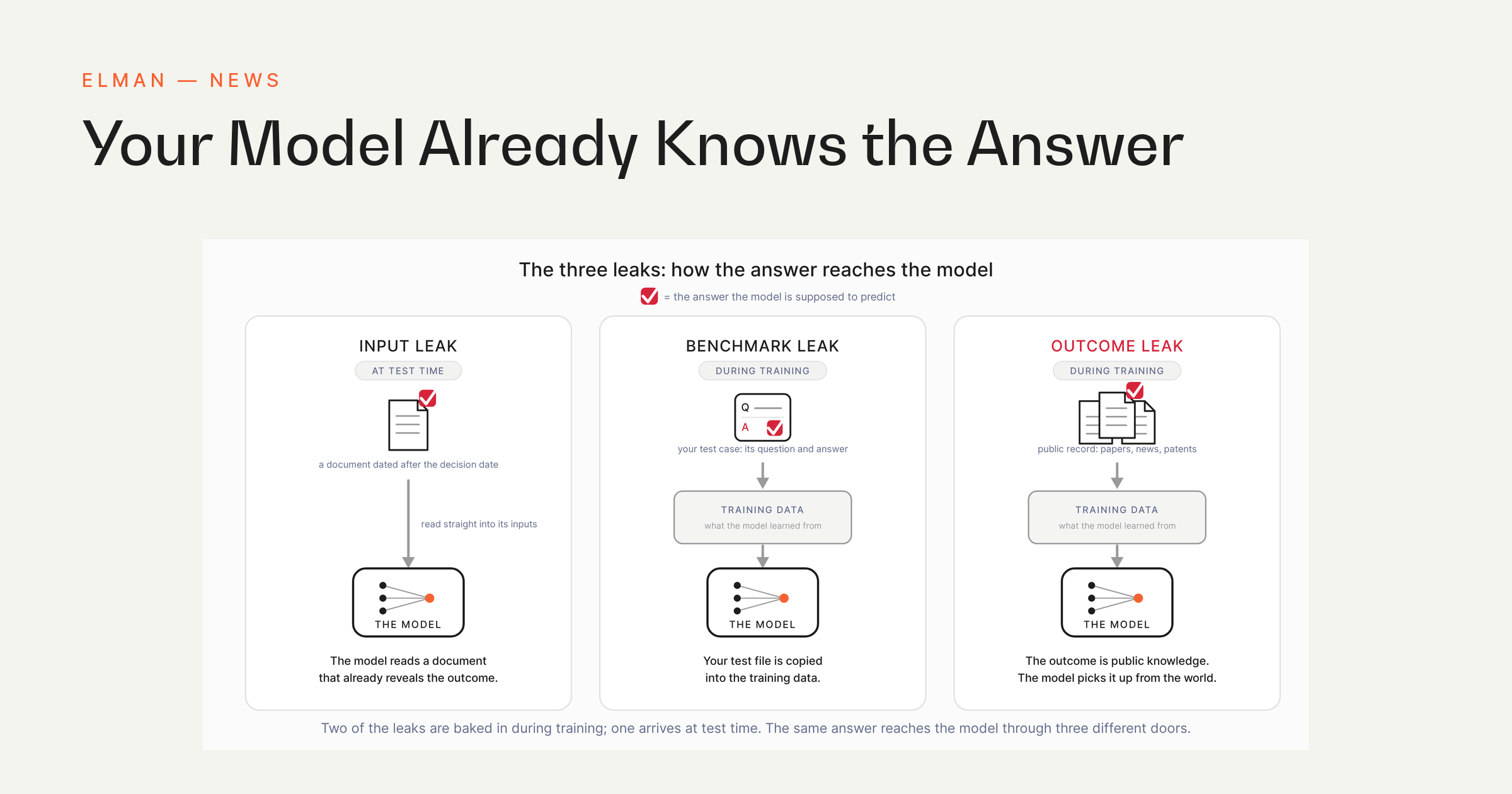
Your model already knows the answer: how benchmark answers leak into LLMs

Why it matters — Engineers depend on benchmark scores to gauge model reasoning and to choose systems for production. If a model simply recalls an answer it has seen, the score no longer reflects true capability, leading to over-optimistic deployments. Switching to forward-looking or live benchmarks can restore confidence but requires new data pipelines and may not be viable for all tasks.

1 feed
13 min
73 142 new

Performance github.com

Argus introduces agentic UI testing with five-agent pipeline and no selectors

Why it matters — For teams whose coding agents outpace QA, Argus offers a way to describe tests in plain language and have an autonomous agent execute them in a real browser. It runs locally with SQLite storage and no telemetry, so data stays on the machine. The trade-off is that it requires a Gemini API key and Python/Node setup, and it only works against HTTP(S) targets.

1 feed
5 min
74 142 new

Performance artificialanalysis.ai

GLM-5.3 achieves top-tier intelligence score at below-median cost in Artificial Analysis benchmarks

Why it matters — Engineers selecting large language models for production systems must balance capability against cost. GLM-5.3 demonstrates that high intelligence scores need not come with premium pricing, potentially reducing operational expenses for token-heavy workloads. The model’s verbosity may however increase downstream processing requirements.

1 feed
26 min
77 142 new

Performance github.com

Show HN: SIMD Viterbi Decoder in Rust

Why it matters — Only one feed elseif tracks has carried this so far, so there is no independent corroboration yet. Read it as a single-source report.

1 feed
3 min
78 142 new

Performance ruurtjan.com

Autocomplete for 240M domains hits p99 0 ms via keyDown prefetch

Why it matters — For engineers building search or autocomplete, this shows a practical way to hide API latency by using the time between key presses. The approach combines an in-memory trie for popular domains with a memory-mapped block index for the long tail, keeping the API fast enough to return before the user releases the key.

1 feed
6 min
79 142 new

Performance ashbyhq.com

LiteLLM (YC W23) Is Hiring – Rust / Performance Engineers

Why it matters — A YC-backed startup investing in Rust-specific performance roles signals that throughput and latency optimization are becoming critical constraints as they scale. For engineers tracking hiring demand, Rust performance skills remain a differentiator.

1 feed
4 min
80 142 new

Performance zenodo.org

Spin audit of SQD/QSCI quantum-chemistry benchmarks on iron–sulfur clusters

Why it matters — Quantum chemistry simulations on near-term hardware rely on these benchmarks as proof of utility. If the spin state is wrong, the energy value is meaningless for chemical accuracy. Teams building or validating quantum algorithms must now add spin-moment checks to their benchmarking pipelines.

1 feed
2 min
82 139 new

Performance maplant.com

25x Performance, Three Optimizations

Why it matters — Only one feed elseif tracks has carried this so far, so there is no independent corroboration yet. Read it as a single-source report.

1 feed
13 min
83 139 new

Performance youtube.com

Performance profiling Mutter, GNOME Shell & apps with Tracy

Why it matters — Engineers debugging GNOME-based desktop environments or applications can now use Tracy for detailed performance analysis. This may reduce the effort needed to identify bottlenecks in compositor or shell code. Without additional context, the scope of adoption or required changes remains unclear.

1 feed
4 min
86 131 -1

Performance Tomshardware

China's open-weight AI models reportedly just 4 months behind US models at 30% of the price

Why it matters — The report highlights significant progress in the capabilities of Chinese open-weight AI models, specifically Kimi K3. While these models are now more competitive in performance, their lower cost of operation presents a notable advantage for developers and businesses considering AI solutions. However, potential users should be aware of the limitations and requirements of these models.

1 feed
4 min
87 129 new

Performance Kotlin

Kodee’s Kotlin Roundup: Birthday Wishes, Shipaton 2026, and the New Kotlin AI Benchmark

Why it matters — The 2.4.10 release gives developers a fresh baseline for any performance or stability improvements. The AI benchmark supplies the first community-wide reference point for measuring how Kotlin-targeted coding agents perform. The competition and BlueJ support encourage broader adoption and experimentation across platforms and education.

1 feed
1 min
88 129 new

Performance ClickHouse

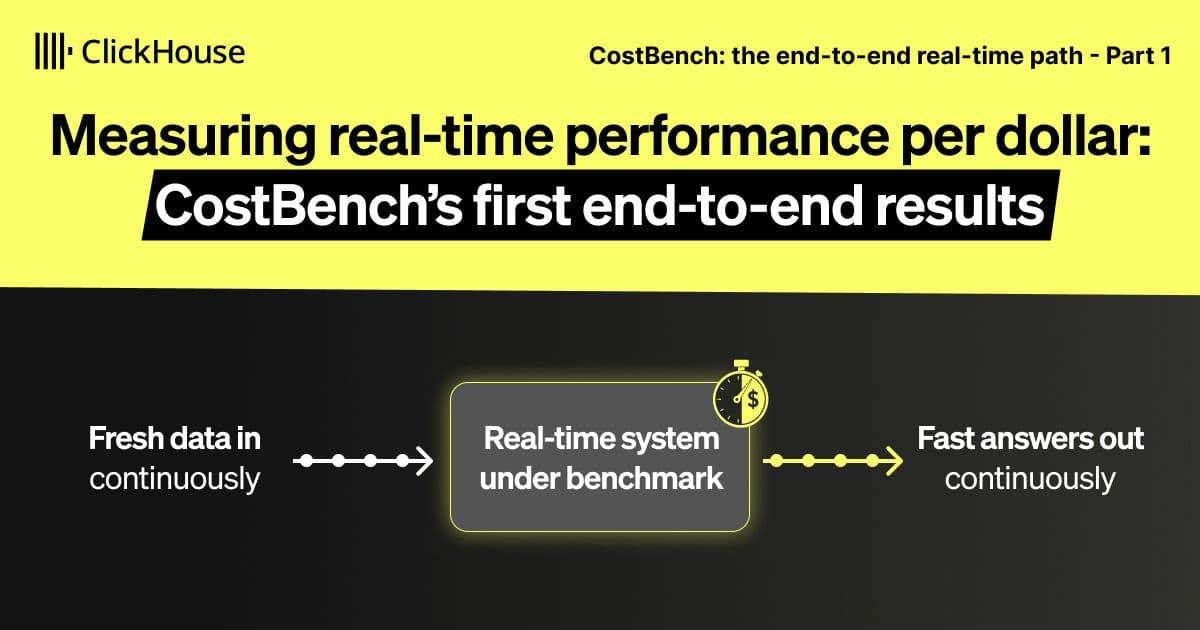
Measuring real-time performance per dollar under continuous load: CostBench’s first end-to-end results

Why it matters — This benchmark measures the full real-time analytics path from ingestion to query readiness to query serving, not just query speed on static data. For engineers evaluating warehouses for continuous-ingest workloads, it captures a combined cost metric that reflects both data preparation and query execution expenses. The results come from a ClickHouse-authored benchmark with no independent corroboration yet.

1 feed
16 min
89 129 new

Performance ClickHouse

The Agentic Analytics Benchmark: Measuring model accuracy and efficiency in analytical agents

Why it matters — Agentic analytics systems require models to dynamically discover schemas and execute multi-step queries, unlike static text-to-SQL benchmarks. This framework lets engineers test models against their own data warehouses to identify the best trade-off between accuracy and cost. The results show significant cost disparities between models with only marginal accuracy differences.

1 feed
18 min
92 124 new

Performance streamhpc.com

The LuaJIT NYI That Silently Poisoned an Unrelated Hot Loop

Why it matters — Engineers relying on LuaJIT for predictable speed may see their hot code paths intermittently fall back to interpretation without any obvious source change. This nondeterministic slowdown can waste compute resources and complicate performance testing. Guarding against the pattern or detecting NYI usage in CI helps maintain stable performance.

1 feed
13 min
94 124 new

Performance gnu.org

Toy interpreter gains JIT compilation via libgccjit for faster execution

Why it matters — Engineers experimenting with interpreters or dynamic language runtimes can use this as a reference for integrating JIT compilation. The example highlights trade-offs between simplicity and performance in interpreter design. No production-ready optimizations are claimed, but the approach shows how JIT can be incrementally added to existing bytecode interpreters

1 feed
23 min
95 124 new

Performance decuser.github.io

Aiki Alpha 3 reduces runtime overhead and adds adaptive number and list representations

Why it matters — Engineers building or evaluating Aiki can now expect lower runtime costs without changing program logic. The adaptive representations for numbers and lists may reduce memory pressure, but the exactness guarantees remain intact. Profiling and coverage tooling are now unified, simplifying performance analysis.

1 feed
4 min
97 124 new

Performance bahjeez.com

Fake flash microSD cards can be made usable by adjusting partition table, ongoing tests show

Why it matters — For engineers using microSD cards in embedded systems or single-board computers, the distinction between advertised and physical capacity is critical. The article's method for detecting fake flash and adjusting partitions offers a way to salvage cheap cards, but the ongoing endurance tests will reveal whether they are reliable for long-term writes.

1 feed
67 min
98 124 new

Performance haxx.se

curl launches public performance test suite running every twenty minutes on a developer's local machine

Why it matters — Making performance numbers public immediately prompted curl developers to propose and merge changes that improved some metrics within hours. The setup is deliberately imperfect, running on a single-user development machine rather than dedicated hardware, but the project chose shipping something over waiting for an optimal solution.

1 feed
9 min
99 124 new

Performance eme64.github.io

Performance impact of Alignment

Why it matters — When code moves from scalar to vector operations, the required alignment changes from element size to total vector size, so engineers must ensure proper alignment to avoid hidden costs. Unaligned vector loads that cross cache-line boundaries trigger split operations, which can dominate runtime if memory traffic is already a bottleneck. On legacy CPUs misaligned accesses may even raise faults, forcing compilers to prove alignment before emitting vector instructions.

1 feed
13 min
100 124 new

Performance loshz.com

BPF compiler optimizations break checksum recalculation due to type-based alias analysis

Why it matters — Engineers writing BPF programs must account for compiler optimizations that assume strict aliasing rules, even when working with overlapping memory regions. Failing to do so can introduce subtle bugs that only surface at runtime, such as corrupted checksums in network packets. This highlights the need for defensive coding practices when interacting with low-level memory operations in BPF.

1 feed
6 min
101 124 new

Performance humanistreview.ai

Audrey Tang argues the deeper AI threat is humans adapting to machines, not machines imitating humans

Why it matters — Tang draws a line between tools that extend human capacity and systems that train people to behave like ranking-system components. For engineers building AI products, the essay frames the design question as whether a tool deepens mutual comprehension or rewards people for performing like machines. The piece carries one feed's framing only, so its claims are not independently corroborated here.

1 feed
18 min
103 124 new

Performance kowalczyk.info

C++ markdown parser AST nodes shrunk from 232 bytes to 16 bytes via pointer compression and arena allocation

Why it matters — AST-based markdown parsers pay per-node overhead for every field regardless of node type, so node size directly drives memory consumption on large documents. The techniques shown, arena allocation, 32-bit pointer offsets, and in-place string growth, are transferable to any C++ project that builds large in-memory trees with uniform lifetime. The benchmarks show up to 75% memory reduction on entity-heavy input with no speed regression measured.

1 feed
13 min
104 124 new

Performance signalsandthreads.com

Jane Street podcast episode 18 discusses why trading-system optimization is harder than hyperscale

Why it matters — For engineers optimizing systems, the episode highlights that scale changes the optimization calculus: at hyperscale, tiny gains have huge impact, but trading systems require different techniques due to bursty, low-latency demands. It also covers profiling tools and the differences between optimizing OCaml and C++, which are directly relevant to performance work.

1 feed
64 min
105 124 new

Performance greptime.com

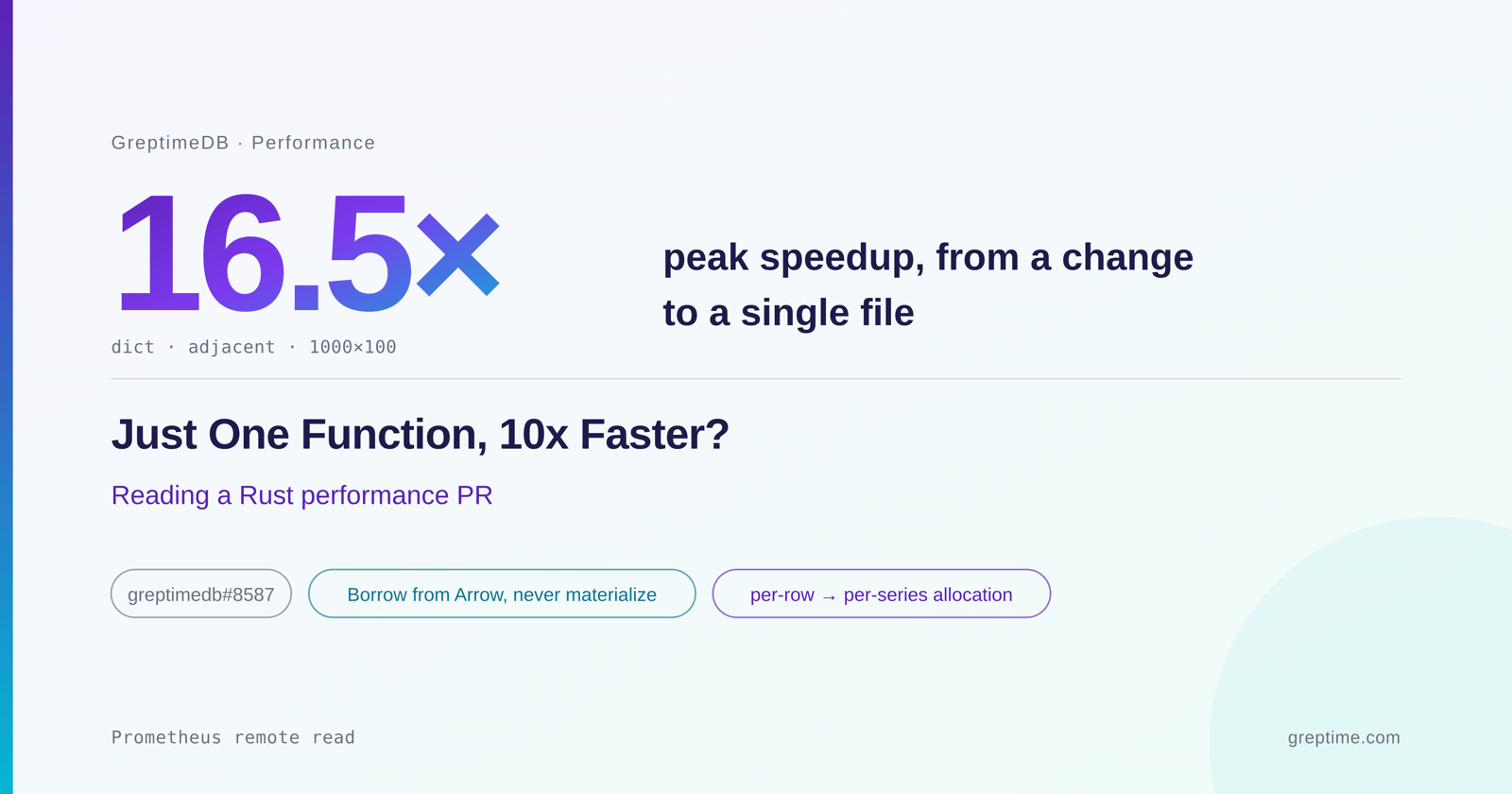
Just One Function, 10x Faster? Reading a Rust Performance PR

Why it matters — The conversion step previously consumed over a third of CPU in a realistic workload, limiting read-throughput. By integrating the optimized version, services can handle many more series per second without additional hardware. Existing deployments need only upgrade to the beta release that includes the change.

1 feed
15 min
106 123 new

Performance github.com

Singeli DSL compiles high-level SIMD abstractions to C

Why it matters — For engineers writing performance-critical code, Singeli offers a metaprogramming approach to generate specialized SIMD code without hand-writing assembly. It is already used in production in CBQN with 5k lines, suggesting it is usable. However, the standard includes for sophisticated SIMD instructions are less solid, so adopting it may require extending the language.

1 feed
33 min
107 121 new

Performance Techmeme

Nuance Labs reportedly raises $50M Series A for low-latency AI avatars with face-to-face conversational ability

Why it matters — This funding signals growing investment in AI systems that prioritize real-time interaction, a critical requirement for applications like customer service, telepresence, or virtual assistants. Engineers working on latency-sensitive AI may need to evaluate whether Nuance Labs' approach offers a viable alternative to existing solutions.

1 feed
78 min
108 115 new

Performance Phoronix

PHP 8.6 reportedly improves JIT performance over PHP 7.4 through 8.5

Why it matters — Performance benchmarks help engineers assess whether upgrading PHP versions will yield measurable improvements for their applications. If JIT optimizations in PHP 8.6 deliver significant speedups, migration may justify the effort for latency-sensitive workloads. However, without detailed results, the practical impact remains unclear.

1 feed
2 min
112 111 new

Performance Techmeme

Apple releases Mac mini with M6 and M5 Pro chips claiming up to 4x faster AI and 2x faster graphics

Why it matters — This update signals Apple’s push to dominate local AI workloads and high-performance computing on macOS. Engineers working on AI models or graphics-intensive tasks may see significant speedups, but adoption depends on software optimization for the new hardware. The lack of a formal event suggests urgency in competing with AI-focused hardware from other vendors

1 feed
61 min
113 111 new

Performance Techmeme

OpenAI's forthcoming Astra model reportedly uses "recurrent depth" to cut costs and boost performance while obscuring its reasoning

Why it matters — The trade-off between inference efficiency and reasoning observability creates a direct tension for teams that need to audit, debug, or build safety tooling around model behavior. If recurrent depth obscures reasoning traces, the visibility that engineers rely on for alignment and compliance work may degrade even as costs drop. Only one feed is carrying this story, so the specifics should be treated with caution until corroborated.

1 feed
85 min
114 111 new

Performance Techmeme

Anthropic reportedly in talks to acquire Decart's real-time generative video and GPU optimization tech for about $6B

Why it matters — If completed, this acquisition would give Anthropic GPU optimization capabilities and real-time generative video technology, both areas outside its current text-focused offerings. Engineers building on Anthropic's platform could see future multimodal capabilities and potentially more cost-effective inference as a result.

1 feed
79 min
116 111 new

Performance Techmeme

DeepSeek launches V4-Pro model that rivals Kimi K3 on some benchmarks at $0.44 input and $0.87 output per million tokens

Why it matters — DeepSeek offers V4-Pro at much lower prices than competing models, reducing token cost for developers. The model rivals Kimi K3 on some benchmarks, providing comparable performance at reduced expense. This pricing advantage may influence teams choosing models for cost-sensitive applications.

1 feed
77 min
117 111 new

Performance Techmeme

Pixel 11 Pro review finds useful Magic Capture and Rambler but subpar gaming and useless HiLight

Why it matters — The Pixel 11 Pro demonstrates that Google's software and AI capabilities can deliver genuinely useful features like advanced voice-to-text, but the device still falls short on GPU-intensive workloads and includes hardware additions that add no practical value. For engineers, this confirms the platform's strengths remain in ML-driven experiences rather than raw compute or peripheral hardware design.

1 feed
92 min
119 111 new

Performance Techmeme

US corporate spending on equipment and facilities forecast to rise 40% from 2021 to 2027, over 3x Europe's pace, driven by AI race

Why it matters — The forecast points to a widening capital expenditure gap between the US and Europe in high-tech infrastructure, with AI competition as the stated cause. For engineering teams, this suggests US-based operations will see accelerating investment in equipment and facilities while European counterparts may face a comparatively slower build-out.

1 feed
43 min